Yes, a HEPA filter air purifier for home use really works, but only on what it is built to handle: airborne particles such as dust, pollen, smoke particles and PM2.5. It does not remove gases or the dust already settled on your sofa and mattress. It helps only when it is the right size for the room and is actually kept running.
This guide explains how a HEPA purifier works and what research says about its benefits. It also covers what to check before buying in India, including a simple way to size one for your room, and where a purifier falls short, so your money goes where it helps.
What Is a HEPA Filter Air Purifier for Home?
A HEPA filter air purifier is a portable machine that uses a fan to pull room air through a dense mesh of fine fibres called a HEPA filter. HEPA stands for High Efficiency Particulate Air. Under the commonly used US standard, a true HEPA filter must capture at least 99.97 per cent of particles of 0.3 microns. In the European grading used on many purifiers sold in India, H13 means at least 99.95 per cent and H14 at least 99.995 per cent.
A micron is a thousandth of a millimetre. A human hair is around 70 microns wide, pollen grains are typically 10 to 100 microns, and PM2.5 refers to particles of 2.5 microns or smaller. The 0.3 micron figure is used because particles around that size are the hardest for the filter to catch. Larger and smaller particles are caught even more efficiently.
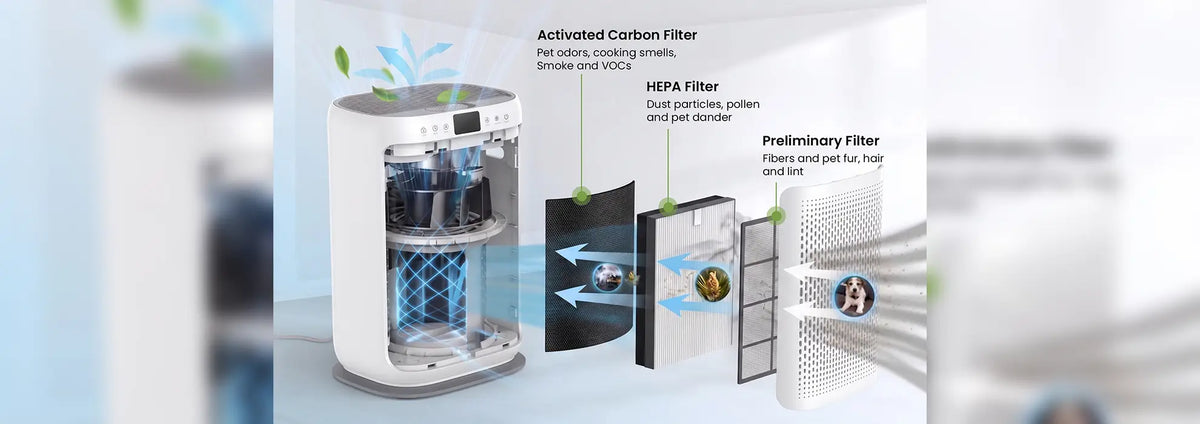
Most home purifiers combine three stages:
- Pre-filter: catches hair and large dust.
- HEPA filter: captures fine particles.
- Activated carbon layer: adsorbs some odours and gases.
Labels such as “HEPA-type” or “HEPA-like” have no fixed standard behind them. Treat them as marketing language until a filter grade or test result backs them up.
How Does a HEPA Air Purifier Work?
- The fan draws in room air through the intake.
- The pre-filter catches hair, lint and large dust, which protects the HEPA filter and extends its life.
- The HEPA filter traps fine particles as air passes through. Particles either hit and stick to fibres, get close enough to be caught, or drift into fibres through random motion.
- The carbon layer adsorbs some gases and odours.
- Cleaner air returns to the room.
A purifier does not clean a room in one pass. It cleans the same air again and again, so what matters is how much air it moves per hour, a figure called CADR, compared with your room size. The 99.97 per cent figure also describes the filter, not the whole machine. Air that leaks around a poorly sealed filter is not cleaned, which is why a unit’s tested CADR says more about real performance than the filter grade alone.
Does a HEPA Air Purifier Really Work?
It works well for particles. For health, the evidence is encouraging but modest.
On particles: Systematic reviews of studies in homes, schools and offices found that portable purifiers cut indoor PM2.5 by roughly 23 to 92 per cent compared with no purifier. A 2026 review of 36 studies found HEPA-based systems typically lower indoor particulate matter by 20 to 80 per cent. The wide range comes from room size, how long the unit ran and where the pollution came from.
On health: Pooled trial results show small average reductions in blood pressure with real filtration compared with sham filtration, roughly 2 to 4 mmHg systolic in a 2023 meta-analysis. Evidence for breathing symptoms, long-term outcomes and cognition is limited and inconsistent. A purifier is a reasonable, low-risk step toward cleaner indoor air, not a proven treatment.
On its role: Public health guidance treats portable air cleaners as a supplement to source control and ventilation, not a replacement.
What a HEPA purifier can and cannot do
| What you want to remove | Does a HEPA purifier help? | Notes |
|---|---|---|
| Smoke particles, PM2.5, fine dust | Yes, this is its strongest use | Results depend on CADR and running time |
| Pollen and pet dander in the air | Yes | Allergens already settled on bedding and sofas stay put and need cleaning |
| Mould spores in the air | Partly | It cannot fix the damp that lets mould grow |
| Dust mites | Only airborne fragments | Mites live in mattresses and upholstery, so a dust mite vacuum cleaner and regular washing do that job |
| Viruses and bacteria carried on particles | Reduces some airborne particles | One layer alongside ventilation, not protection by itself |
| Cooking smells, fumes and VOCs | Limited, and only with a substantial carbon layer | Thin carbon layers have limited capacity, so ventilate and use an exhaust fan |
| Carbon monoxide and carbon dioxide | No | Needs ventilation, and a CO alarm near gas or fuel burners |
Why some people feel it did not work
The usual reasons are an undersized unit, a clogged filter, running it for only an hour, doors left open to a larger space, a pollution source that never stops, or expecting it to remove smells. Fix those and most disappointments disappear.
How to Choose a HEPA Filter Air Purifier for Home in India
Check these in order of importance.
1. Filter grade
Choose true HEPA at H13 or H14 and ask which standard it was tested to. H13 is generally considered sufficient for homes, and H14 is a bonus. Grades E10 to E12 are not HEPA. “HEPA-type” is not enough.
2. CADR
CADR, or Clean Air Delivery Rate, is the volume of cleaned air a unit delivers per hour, usually in m³/h. It is the most useful single number for comparing purifiers. Standard tests report separate figures for smoke, dust and pollen, so if a listing shows only one number, check which one it is and whether it was independently tested.
3. Room size, using air changes per hour
A common target is four to five air changes per hour, meaning the purifier cleans a volume of air equal to your room four to five times every hour. If the budget forces a smaller unit, you still get benefit, but the cleaning is slower.
- Measure length, width and ceiling height in feet.
- Multiply them to get cubic feet, then multiply by 0.0283 to get cubic metres.
- Multiply the volume in m³ by 4 to 5. That is the CADR you need in m³/h.
Example: a 12 ft by 12 ft bedroom with a 9 ft ceiling is 1,296 cubic feet, about 37 m³. It needs roughly 145 to 185 m³/h.
| Room size (sq ft) | Approx. volume (m³, 9 ft ceiling) | CADR needed at 4 air changes per hour (m³/h) | CADR needed at 5 air changes per hour (m³/h) |
|---|---|---|---|
| 100 | 25 | about 100 | about 125 |
| 150 | 38 | about 155 | about 190 |
| 200 | 51 | about 205 | about 255 |
| 300 | 76 | about 305 | about 380 |
| 400 | 102 | about 410 | about 510 |
For a 9 ft ceiling, a quick shortcut is area in sq ft multiplied by 1.0 to 1.3. For a 10 ft ceiling, use 1.1 to 1.4. Some rules of thumb online use CADR in cubic feet per minute, and one cfm is about 1.7 m³/h. Mixing the two units gives you a machine that is too small. Coverage claims in sq ft are also not always calculated at the same air-change rate, so compare CADR, not coverage.
4. Noise
Check the noise level at the fan speed you will actually use. A purifier that is too loud at the speed it needs will end up switched off. For bedrooms, look for a genuine sleep or low-speed mode.
5. Filter and running costs
Ask how often the filter needs replacing, what it costs and whether it is easy to buy in India. Intervals of six to twelve months are common, though heavy pollution can shorten them. Also check rated wattage, since the purifier runs for hours every day.
6. Sensors and smart features
A PM2.5 display, auto mode and Wi-Fi control are conveniences, not performance. Built-in sensors in home units are indicative, so use them to watch trends rather than treat the number as exact. Scent or aroma functions add fragrance to the air, so switch them off if anyone at home has asthma or is fragrance-sensitive.
7. Safety
Avoid ozone generators and ionisers that produce ozone, which is a lung irritant. If a unit has any ionising function, look for low-ozone certification from a recognised testing body.
8. Service and warranty
An air purifier is a long-term appliance. Check the warranty, the availability of replacement filters and whether service is available in your city. If you want to compare models side by side, browse these HEPA air purifiers.
HEPA Purifier vs Other Options
| Option | What it does | Best for | Limits |
|---|---|---|---|
| True HEPA purifier | Filters particles from room air | PM2.5, dust, pollen, smoke particles | Needs the right size and filter changes. Does little for settled dust or most gases. |
| HEPA filter in a vacuum or robot cleaner | Stops fine dust blowing back out while cleaning | Floors and fabrics | Works only while the cleaner runs. It does not clean room air between sessions. |
| Electrostatic or ionic purifier | Charges particles so they collect on plates or surfaces | Some smaller spaces | Performance varies and some units emit ozone |
| Ozone generator | Produces ozone on purpose | Not recommended | Ozone is a lung irritant |
| Opening windows | Brings in outdoor air | Clearing cooking fumes and CO2 when outdoor air is clean | Lets pollution in when outdoor air quality is poor |
Who Benefits Most From a HEPA Purifier?
A purifier tends to give the clearest benefit in these situations:
- Homes in high-pollution cities, or near construction and busy roads
- Households with dust or pollen allergies or asthma, as one part of a plan agreed with a doctor
- Homes with pets
- Homes with infants, older adults or people with heart or lung conditions, after checking with a doctor
- People who sleep or work mostly in one closed, air-conditioned room
If outdoor air is generally clean and your home is well ventilated, you may get more from spending first on regular cleaning and ventilation.
How to Get the Best Results From Your Purifier
- Run it consistently. Particle sources are continuous, so auto or low speed for most of the day works better than short bursts. Raise the speed after cooking, dusting or smoke.
- Close doors and windows when outdoor air is poor, and ventilate when outdoor air improves.
- Leave clear space around the intake and outlet, following the manual, rather than pushing the unit into a corner.
- Use one purifier per room you spend time in, with doors closed.
- Check the pre-filter every few weeks and clean it as the manual says. Replace the HEPA filter on schedule.
- Reduce the source. Dust control matters as much as filtering. Regular floor cleaning, such as choosing a robotic floor cleaner, and vacuuming your mattress keep settled dust from returning to the air.
- Avoid indoor smoke sources such as incense, mosquito coils and smoking, since a purifier cannot keep up with a constant source.
Common Challenges and Solutions
| Challenge | Why it happens | What helps |
|---|---|---|
| I cannot see any difference | The unit is undersized, or you are expecting odour removal | Recheck CADR against room volume and set realistic expectations |
| Smells remain | Thin carbon layers have limited capacity | Ventilate, use an exhaust fan and remove the odour source |
| PM2.5 reading rises after cooking | Cooking releases particles quickly | Switch to a higher speed for a while, then return to auto |
| The unit is too loud | It is working too hard for the room | Choose a higher CADR so it can run slower |
| Filters seem to wear out quickly | Heavy pollution or all-day use | Replace by condition and schedule, and keep the pre-filter clean |
| Airflow feels weak | The pre-filter or HEPA filter is clogged | Clean the pre-filter and replace the HEPA filter if due |
Practical Situations in India
- Diwali and festival nights: fireworks smoke can raise indoor PM2.5 within minutes. Close windows before the evening, run the purifier at a higher speed during and after the peak, then drop to auto.
- Winter smog in North India: outdoor air can be poor for days, so a correctly sized purifier in the bedroom and living room matters most.
- Open kitchens: cooking releases particles and fumes. Use the chimney or exhaust fan and boost the purifier for a short time afterwards.
- Construction dust: the pre-filter loads quickly, so check it more often.
- Monsoon humidity: a purifier cannot remove damp, so tackle leaks and damp walls separately.
- Air-conditioned rooms: closed rooms suit a purifier well, but ventilate periodically to keep fresh air coming in.
Common Questions People Ask
Is a HEPA air purifier worth it for a home in India?
Often yes in cities with regularly high PM2.5, especially for bedrooms and for households with allergies, children or older adults. If your outdoor air is usually clean and your home is well ventilated, the benefit is smaller.
How many hours a day should I run it?
Run it on auto or low speed for most of the hours you are in the room, and raise the speed after cooking, cleaning or smoke. Running it while you sleep is useful, because you spend long hours in one room.
What is the difference between HEPA, true HEPA, HEPA-type and H13?
True HEPA meets a defined efficiency standard, such as 99.97 per cent at 0.3 microns. H13 and H14 are European grades of true HEPA. “HEPA-type” and “HEPA-like” have no fixed standard behind them.
Can an air purifier replace cleaning and vacuuming?
No. A purifier handles particles in the air, while vacuuming and washing remove dust and allergens on surfaces. They work together.
FAQs
Does a HEPA air purifier remove viruses?
It can reduce the airborne particles and droplets that carry viruses, but it does not make a room virus-free and is not a treatment. Think of it as one layer alongside fresh-air ventilation, good hygiene and staying home when unwell.
Can I wash a HEPA filter, and how often should I change it?
A true HEPA filter should not be washed, because water damages the fine fibres and lowers efficiency. Follow the manufacturer’s replacement interval. Intervals of six to twelve months are common, though some makers recommend more frequent changes. Change it sooner if you live in a heavily polluted area, run the unit all day or notice weaker airflow. The washable part is usually the pre-filter, which you can clean as the manual describes.
How much electricity does an air purifier use?
Most home units draw tens of watts at normal fan speeds, with higher draw on the top speed, so check the rated wattage on the label. To estimate the cost, multiply watts by hours of use and divide by 1,000 to get units (kWh), then multiply by your tariff. For example, a 40 W unit running 10 hours uses 0.4 units a day, which costs about ₹3 if your tariff is ₹8 per unit.
Can one air purifier clean my whole house?
Not usually. A portable purifier cleans the air in the room where it runs, and its performance falls if doors stay open to a larger space. For several rooms, use a unit in each room you spend most time in, such as the bedroom and living room, or choose a higher CADR for an open-plan area.
Is it safe to run an air purifier all night in the bedroom?
Yes, if it is a filter-based unit that does not produce ozone. Use the sleep or low-speed mode to keep noise down, keep a clear gap around it and avoid pointing the airflow directly at the bed. Do not run scent functions overnight if anyone in the room is sensitive to fragrance.
Do air purifiers with ioniser or UV features work better?
Not necessarily. The filtration does the proven work of removing particles. Ionisers and some other electronic technologies can produce ozone, a lung irritant, and the added benefit of UV inside a purifier is hard to verify. Prefer a filter-based unit with a true HEPA filter, and check for low-ozone certification if the unit has any ionising function.
Will a HEPA air purifier cure asthma or allergies?
No. It can lower airborne triggers such as dust, pollen and smoke particles, and studies show mixed results for symptom relief. Treat it as one part of a plan that includes your doctor’s advice, medication, regular cleaning and trigger control, and ask your doctor if you have asthma or severe allergies.
Key Takeaways
- A HEPA purifier works on airborne particles such as PM2.5, dust, pollen and smoke particles, not on gases or settled dust.
- Choose true HEPA at H13 or H14, and avoid “HEPA-type” labels.
- Size by CADR, not by coverage claims: aim for about 4 to 5 air changes per hour using your room volume.
- Health evidence is modest and mixed, so treat a purifier as one step alongside ventilation and cleaning.
- Avoid ozone-producing units, and switch off scent functions if anyone is sensitive.
- Run it consistently, keep doors closed and replace filters on schedule.
- Check running costs and filter availability before you buy.
Also, Read How a Self Cleaning Robot Vacuum and Mop Suits Diwali Gifting
Conclusion
A HEPA filter air purifier for home use is worth buying when it is the right size, has a true HEPA filter and is run consistently alongside good cleaning and ventilation habits. Judge any model by its filter grade, its tested CADR for your room and the cost and availability of replacement filters, not by feature lists. If you are comparing options, Robolta’s Oxiolta air purifier range pairs a pre-filter, H13 True HEPA and activated carbon with a live PM2.5 display, and the Pure Max lists a CADR of 250 m³/h, so use the table above to check that figure against your own room before you buy.
Share:
How a Self Cleaning Robot Vacuum and Mop Suits Diwali Gifting