
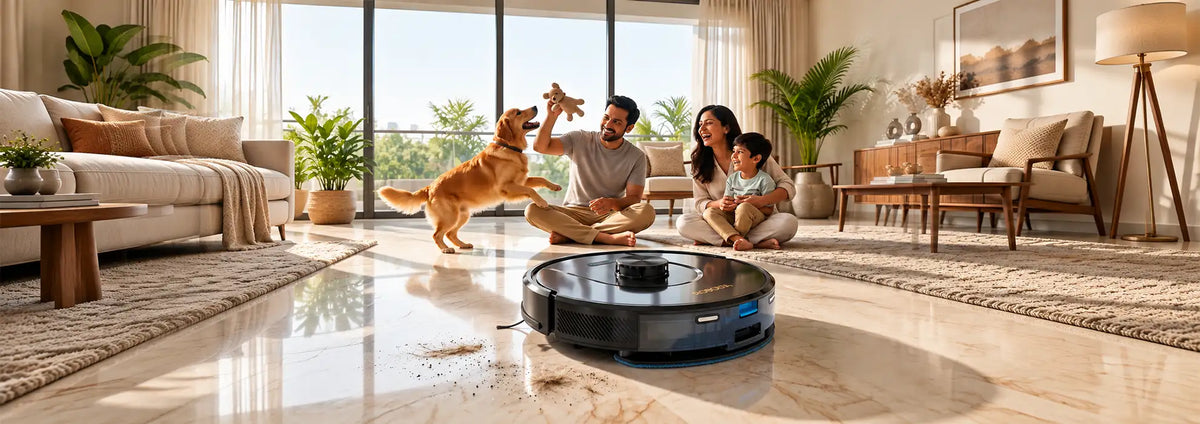
A robotic vacuum cleaner can move around your home, identify obstacles, clean the floor and return to its charging station without being manually pushed from one room to another. But how does it actually know where to go?
The answer lies in a combination of sensors, navigation technology, mapping, motors, brushes, suction and software. Modern robotic vacuum cleaners are designed to understand their surroundings, plan cleaning routes and make adjustments as they move.
Some models go further by adding features such as LiDAR navigation, automatic dust collection, mopping, carpet detection and self-maintenance. Understanding how these systems work can make it easier to choose a robotic vacuum cleaner that suits your home.
Robolta develops smart cleaning solutions for Indian homes, with robotic cleaners designed around everyday household cleaning needs. Its current range includes models such as the R2 Pro, R2 Max and R6 Pro, each offering different levels of cleaning and automation.
What Is a Fully Automatic Robotic Vacuum Cleaner?
A fully automatic robotic vacuum cleaner is a compact cleaning appliance that can move around a home and clean floors with limited manual intervention. Instead of carrying a traditional vacuum from one room to another, the robot handles its own movement and navigation.
Depending on the model, a robotic vacuum cleaner may be able to:
- Navigate around rooms
- Detect walls and obstacles
- Create or use a map of the home
- Follow a planned cleaning route
- Collect dust and debris
- Adjust cleaning behaviour for different surfaces
- Return to its charging station
- Resume cleaning after charging on supported model
The level of automation varies between models. Some focus mainly on automated vacuuming, while more advanced models can also handle mopping, dust collection and other maintenance tasks.
How Does a Robotic Vacuum Cleaner Work Step by Step?
The easiest way to understand a robotic vacuum cleaner is to look at what happens during a typical cleaning cycle.
It Scans Its Surroundings
Before a robot can navigate efficiently, it needs information about the space around it. Depending on the model, this can involve technologies such as LiDAR, laser radar and other sensors.
These systems help the robot understand distances, identify walls and recognise objects around its path.
For example, the Robolta R2 Pro uses LiDAR 3.0 navigation, while the R6 Pro uses 360° Laser Radar with SLAM navigation. These technologies provide the robot with information that supports mapping and navigation.
It Creates a Map of the Home
After gathering information about its surroundings, the robot can use that information to create a digital representation of the area it needs to clean.
A mapped robotic vacuum does not simply move around the floor without a plan. It can use information about the layout of the space to understand where different areas are located and organise its movement accordingly.
This is one of the important differences between modern smart robotic vacuums and basic random-navigation models.
The Robolta R2 Pro, for example, uses spatial mapping to create a digital blueprint of the home for structured cleaning.
It Plans a Cleaning Route
Once the robot has information about the cleaning area, its navigation system helps determine how it should move through the space.
A planned route can help the robot work through different areas systematically instead of repeatedly travelling over the same section while missing another.
The exact route depends on the model, its navigation system and the layout of the home. The important part is that the robot uses information from its surroundings to decide where it should move next.
Sensors Help It Avoid Obstacles
A home is rarely an empty space. Furniture, walls and other objects can interrupt the robot's route.
Sensors help a robotic vacuum detect these obstacles and change its direction. It may slow down, turn or navigate around an object instead of continuously moving towards it.
This allows the robot to operate in everyday rooms where furniture and other household objects are present.
It Detects Stairs and Drop-Offs
A robotic vacuum also needs to recognise situations where moving forward could cause it to fall.
Sensors designed to detect changes in floor level can help the robot identify stairs and other drop-offs. When such an area is detected, the robot can change direction instead of continuing forward.
This type of detection works in the background throughout the cleaning process and is an important part of autonomous navigation.
How Does LiDAR Help a Robotic Vacuum Cleaner?
LiDAR stands for Light Detection and Ranging. It uses laser-based sensing to measure distances and gather information about the surrounding environment.
In a robotic vacuum cleaner, LiDAR can help the navigation system understand the position of walls, estimate distances and build a map of the cleaning area.
This information can then support:
- Room mapping
- Position tracking
- Route planning
- Navigation
- Obstacle avoidance
The Robolta R2 Pro uses LiDAR 3.0 navigation, while the R2 Max uses LiDAR-based mapping. The R6 Pro combines 360° Laser Radar with SLAM navigation.
LiDAR is therefore not the cleaning mechanism itself. Its main role is to help the robot understand and navigate its surroundings.
What Is SLAM in a Robotic Vacuum Cleaner?
SLAM stands for Simultaneous Localisation and Mapping.
In simple terms, SLAM allows a robot to work out where it is while creating or updating a map of its surroundings.
Imagine walking through an unfamiliar home while drawing a map and continuously figuring out your own position on that map. A robotic vacuum using SLAM performs a similar process through sensors and software.
The Robolta R6 Pro uses 360° Laser Radar with SLAM navigation. This helps the robot understand its position in relation to the environment while carrying out its cleaning route.
How Does a Robotic Vacuum Actually Clean the Floor?
Navigation helps the robot decide where to move, but the actual cleaning is performed through a combination of brushes and suction.
Side Brushes
Side brushes help move dust and debris from areas near walls and edges towards the robot's main cleaning path.
This allows the robot to collect debris from areas that may otherwise be difficult for the main brush to reach.
Main Brush
The main brush helps loosen and collect dust, hair and other debris as the robot travels across the floor.
The design of the brush can vary between models depending on the type of cleaning system used.
Suction
The vacuum motor creates suction that pulls dust and debris into the robot's dust collection system.
Different robotic vacuum cleaners provide different levels of suction. The Robolta R2 Pro offers 5,000Pa suction, the R2 Max offers 7,500Pa, while the R6 Pro provides 12,000Pa suction.
Higher suction is one specification to consider, but it should be viewed alongside navigation, brush design, floor detection and other features when comparing robotic vacuum cleaners.
How Does a Robot Vacuum Know Where It Has Already Cleaned?
Mapping and navigation work together to help the robot organise its cleaning.
The robot uses information about its position and the mapped area to understand where it has travelled and where it needs to go next. This makes the cleaning process more structured than simply moving randomly around the floor.
The exact behaviour varies between models and their software, but the basic process is:
Understand the space → determine its position → plan the route → clean the area → move to the next section.
This is what allows a smart robotic vacuum cleaner to cover a home in a more organised way.
What Happens When the Battery Runs Low?
A robotic vacuum cleaner needs to manage its battery while cleaning. Models with automatic recharge functionality can return to their charging station when the battery becomes low.
The robot then charges so that it is ready for its next cleaning session. Some models can also resume cleaning after charging, depending on their features and software.
The Robolta R2 Pro supports automatic recharge and has a listed runtime of up to three hours. Actual runtime can vary depending on cleaning mode, floor conditions and other factors.
What Happens After the Cleaning Is Finished?
The level of automation after cleaning depends on the robotic vacuum cleaner.
With a standard model, the user may need to empty the dustbin and carry out routine maintenance manually.
More advanced models can automate some of these tasks.
The Robolta R2 Max, for example, comes with an automatic dust collection station that can collect dust from the robot after cleaning. This reduces the need to empty the robot's dustbin after every cleaning session.
The Robolta R6 Pro takes automation further with a self-maintaining station that can handle functions including dust emptying, water refilling, mop washing and mop drying.
This shows why the term "fully automatic" can mean different things depending on the model. It is important to check exactly which functions are automated before choosing a product.
How Does a Robotic Vacuum Handle Different Floor Surfaces?
Homes can have more than one type of flooring, so some robotic vacuum cleaners are designed to adjust their cleaning behaviour when they move between surfaces.
For example, the Robolta R2 Pro and R2 Max include carpet boost, which increases suction when the robot detects carpeted areas. The R6 Pro uses ultrasonic carpet detection.
This can help the robot adapt its cleaning according to the surface it encounters.
However, performance can vary depending on factors such as carpet thickness, floor condition and the specific model.
How Does App Control Work With a Robotic Vacuum Cleaner?
Smartphone app control adds another layer of convenience to automated cleaning.
Instead of manually pressing a button on the robot every time you want to clean, app-based controls can allow you to manage cleaning remotely.
Depending on the model, features can include:
- Starting or stopping cleaning
- Creating cleaning schedules
- Managing cleaning sessions
- Selecting cleaning areas
- Monitoring the robot
Robolta's robotic vacuum range uses the Robolta Smart App for control, while the R2 Pro also supports voice control.
This can be useful when you want to set a regular cleaning routine without manually operating the vacuum each time.
Also, Explore the Benefits of a Wet and Dry Vacuum Cleaner
How Is AI Used in Robotic Vacuum Cleaners?
AI is often associated with modern robotic vacuum cleaners, but it is important to understand what it contributes to the cleaning process.
A robotic vacuum can collect information from its sensors and use software to interpret its surroundings. This can support functions such as navigation, mapping, obstacle handling and adjustments to cleaning behaviour.
Robolta describes its robotic cleaning technology as AI-powered, with its robots designed to understand home layouts, navigate around obstacles, detect dirt and adjust suction according to their surroundings.
In practical terms, the purpose is to help the robot make better decisions while cleaning rather than simply moving around the floor according to a fixed pattern.
How Does a Robotic Vacuum Cleaner Differ From a Regular Vacuum?
The biggest difference is who controls the movement.
With a traditional vacuum cleaner, you generally need to carry or move the appliance, guide the cleaning head and manually move from one area to another.
A robotic vacuum cleaner handles its own movement and navigation. Once a cleaning session is started or scheduled, the robot can travel around the designated area and carry out the cleaning process with limited intervention.
This does not mean that a robotic vacuum eliminates all household cleaning. Users still need to maintain the appliance and handle areas or cleaning tasks that the particular robot is not designed for.
How Does Robolta's Robotic Vacuum Range Work?
Robolta offers robotic cleaning solutions with different levels of automation, suction and navigation technology, allowing households to choose according to their cleaning requirements.
Robolta R2 Pro
For everyday household cleaning, the Robolta R2 Pro combines 5,000Pa suction with LiDAR 3.0 navigation, carpet boost and automatic recharge. It also supports app and voice control, while its mapping system helps it follow a more organised cleaning route around the home.
Robolta R2 Max
For households looking for a higher level of automated cleaning, the Robolta R2 Max combines 7,500Pa suction with LiDAR-based mapping, carpet boost and an automatic dust collection station. Its app-based scheduling also makes it easier to include regular floor cleaning in your daily routine.
Robolta R6 Pro
At a higher level of automation, the Robolta R6 Pro combines 12,000Pa suction with 360° Laser Radar and SLAM navigation. It supports both vacuuming and mopping, along with ultrasonic carpet detection, automatic dust emptying, mop washing and drying, and water refilling through its self-maintaining station.
Can a Robotic Vacuum Cleaner Really Clean Without Human Control?
Modern robotic vacuum cleaners can automate a significant part of routine floor cleaning, but fully automatic does not necessarily mean completely maintenance-free.
The level of automation depends on the model. A robot may be able to navigate, vacuum and recharge automatically, while a more advanced model may also empty its dustbin, mop the floor, wash and dry its mop and manage water automatically.
Users should still follow the manufacturer's maintenance instructions and keep important components such as sensors, brushes and filters in suitable condition.
Regular maintenance helps the robot continue working as intended and can also make the cleaning process more reliable over time.
What Happens Inside a Robotic Vacuum During One Cleaning Cycle?
The complete process can be understood through a simple sequence.
- Scan: The robot gathers information about its surroundings.
- Map: Its navigation system creates or uses a map of the cleaning area.
- Locate: The robot determines its position within the environment.
- Plan: Its software works out how it should move through the space.
- Navigate: Sensors help it move around walls, furniture and other obstacles.
- Clean: Brushes loosen debris while the suction system collects dust.
- Adjust: The robot responds to changes in its surroundings and, on supported models, adjusts its cleaning behaviour for different surfaces.
- Return: When cleaning is complete or the battery needs charging, supported models can return to their dock.
- Maintain: Depending on the model, the dock may charge the robot, collect dust or perform additional maintenance functions.
All of these systems work together to create an automated cleaning process.
Is a Robotic Vacuum Cleaner Useful for Indian Homes?
Indian homes can experience regular dust accumulation, everyday floor traffic and different types of household debris. A robotic vacuum cleaner can automate routine floor cleaning, reducing the need to manually operate a vacuum for every cleaning session.
The right model depends on several factors, including the size and layout of the home, flooring, cleaning requirements and the level of automation you want.
For someone who mainly needs regular vacuuming, a model focused on navigation and suction may be sufficient. If mopping and reduced manual maintenance are also priorities, a more advanced model with additional automation may be worth considering.
Robolta develops its cleaning solutions with Indian homes in mind and focuses on smart cleaning technology designed for everyday household use.
Frequently Asked Questions
How does a fully automatic robotic vacuum cleaner work?
It combines sensors, navigation technology, mapping, brushes, suction and software to move around a home and clean floors with limited manual intervention.
Does every robotic vacuum cleaner use LiDAR?
No. Navigation technology varies between models. The Robolta R2 Pro uses LiDAR 3.0, while the R6 Pro uses 360° Laser Radar with SLAM navigation.
How does a robot vacuum avoid obstacles?
Sensors detect objects and changes in the surrounding environment, allowing the robot to adjust its route and navigate around obstacles.
Does a robotic vacuum return to its charging station automatically?
Supported models can return to their charging station automatically. The Robolta R2 Pro, for example, supports automatic recharge.
Can robotic vacuum cleaners vacuum and mop?
Some models support both functions. The Robolta R6 Pro combines vacuuming and mopping and also provides automatic mop washing and drying through its self-maintaining station.
Does a robotic vacuum cleaner need maintenance?
Yes. The amount of manual maintenance depends on the model. Even highly automated robotic vacuum cleaners require appropriate care and maintenance according to the manufacturer's instructions.
Final Thoughts
A fully automatic robotic vacuum cleaner is more than a small appliance that moves around the floor. It combines sensors, navigation, mapping, software, brushes and suction to understand its surroundings and carry out routine cleaning with less manual effort.
Technologies such as LiDAR and SLAM help supported models navigate and map their environment, while features such as automatic recharge, dust collection and self-maintaining stations can take automation further.
When choosing a robotic vacuum cleaner, it is useful to look beyond suction power alone. Navigation technology, battery performance, floor detection, app controls, mopping capabilities and maintenance features can all affect how the appliance fits into your daily cleaning routine.
With different levels of automation across its range, Robolta focuses on making smart cleaning practical for Indian homes, from everyday robotic vacuuming to more advanced hands-off floor cleaning.
Share:
What Are the Benefits of a Wet and Dry Vacuum Cleaner?